


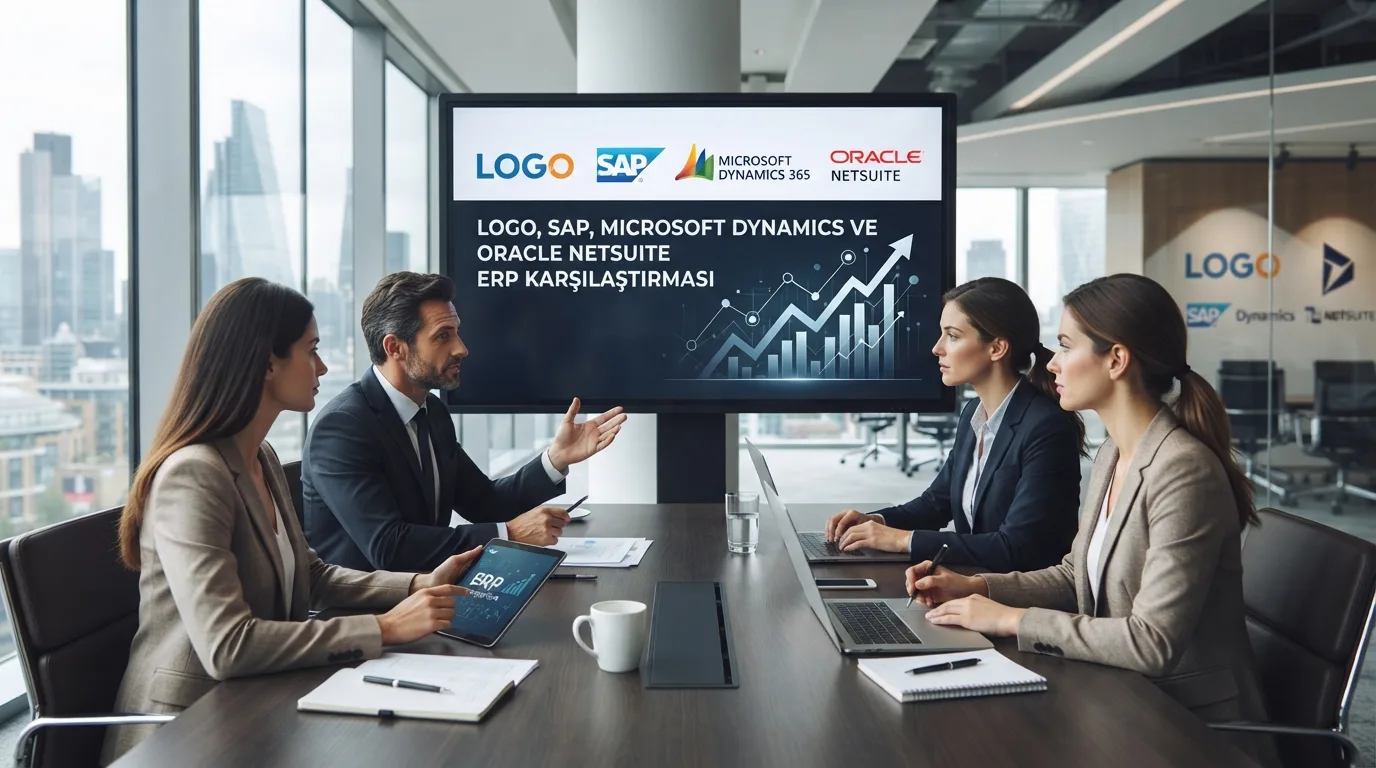
Logo, SAP, Microsoft Dynamics 365, and Oracle NetSuite are among the most widely chosen ERP brands worldwide and in Turkey — but each serves a different business scale and need. The right choice depends less on “which one is better” and more on “which one fits my business’s scale and processes best.” In this article, we compare all four brands by target audience, strengths, and typical use cases.
Overall Positioning of the Four ERP Brands
| Brand | Target Business Scale | Where It Stands Out |
|---|---|---|
| Logo (Tiger3, etc.) | SME – mid-market (Turkish market) | Local regulatory compliance (e-invoice, e-ledger, social security), Turkish-language support |
| Microsoft Dynamics 365 Business Central | Small-to-mid scale (~5-300 users) | Deep integration with the Microsoft ecosystem (Excel, Teams, Power BI) |
| Oracle NetSuite | Fast-growing mid-market (~25-2,000 users) | Cloud-native architecture, multi-entity/multi-currency management |
| SAP S/4HANA | Large enterprise scale | Deep, industry-specific process support and global scalability |
Logo: Advantages Specific to the Turkish Market
Logo Software is the most widely chosen ERP brand among SMEs and mid-sized businesses in Turkey. Its biggest advantage is that Turkey-specific regulatory requirements — e-invoice, e-ledger, e-archive, and social security filings — are natively built into the system, whereas foreign brands typically require an add-on or integration for the same. The breadth of Turkish-language support and the local consulting network is also a practical advantage for SMEs.
Microsoft Dynamics 365 Business Central: Ecosystem Integration
For businesses already using Microsoft 365 (Excel, Outlook, Teams), Business Central offers a familiar interface and native Power BI integration. It’s designed for businesses in the 5-300 user range and can scale as a small business grows into a mid-sized one without needing to switch systems.
Oracle NetSuite: Cloud-Native Speed
NetSuite was built cloud-native from the ground up and is particularly favored by fast-growing businesses operating with multiple entities or multiple currencies (in the 25-2,000 user range). It’s common among software/SaaS companies, e-commerce businesses, and professional services firms.
SAP S/4HANA: Large Enterprise Scale
SAP S/4HANA is designed for large-scale, complex organizations with highly industry-specific processes in sectors like manufacturing, retail, healthcare, and government. Its depth and customization capacity are high, but that depth typically comes with a longer implementation time and higher total cost — for small and mid-sized businesses, it’s often more than they need.
Which Business Should Choose Which Brand?
- If you’re an SME operating in Turkey and local regulatory compliance is your priority → Logo gets you there fastest, with no added integration cost.
- If you’re already working within the Microsoft ecosystem → Business Central shortens the learning curve for your team.
- If you’re fast-growing with a multi-entity/multi-country structure → NetSuite’s cloud-native flexibility is an advantage.
- If you’re large-scale with highly complex, industry-specific processes → SAP’s depth can match that complexity.
Evaluation Criteria for Choosing an ERP
A brand comparison is a good starting point, but the candidates should be scored against the same criteria before you decide. Weight the criteria below by your own priorities to build a simple scorecard.
- Process fit: How much of your critical processes does the standard setup cover, and how much requires customisation?
- Total cost of ownership: Alongside the licence or subscription fee, include implementation, adaptation, training, maintenance and infrastructure costs.
- Deployment model: Which of cloud, on-premises or hybrid suits your IT team and your data policies?
- Integration: How will the system connect to your existing e-commerce, banking, CRM and reporting tools?
- Local support: How easy is it to find experienced implementation consultants in your region?
- Reporting: Can the reports management needs be produced directly from the system?
Questions to Ask During the Demo
A standard presentation makes every product look good. Having the demo run on your own scenarios is what reveals the real differences. Ask these questions:
- Can you show our own order, stock and invoice flow using our sample data?
- Is this requirement met by a standard feature or by additional development?
- How are our customisations affected by version upgrades?
- How, and to what extent, will the data in our current system be migrated?
- How does support work after go-live?
Common Mistakes in the Selection Process
- Watching demos without a requirements list: Write down your processes and mandatory requirements first, then look at products.
- Comparing licence prices only: Implementation and maintenance costs are a significant part of the total.
- Leaving end users out: A choice made without the views of the people who will use the system every day makes adoption harder.
- Deciding for today only: Include plans such as a new branch, a new country or a new sales channel in your evaluation.
To structure your requirements analysis and the comparison of candidate systems, you can draw on our ERP consulting service.
Frequently Asked Questions
Which ERP is better suited for SMEs in Turkey?
If local regulatory compliance (e-invoice, e-ledger, social security) and Turkish-language support are your priority, Logo is the most practical starting point for most SMEs. Businesses with international operations or already on the Microsoft ecosystem should also consider Business Central or NetSuite.
Is there a big price gap between these brands?
Yes, generally speaking: Logo and Business Central tend to have lower starting costs that fit SME budgets, while SAP S/4HANA’s total cost is usually higher due to its scope and implementation time. The exact price depends on user count and module scope, and is clarified through a formal quote.
Can you switch from one brand to another?
Yes, but it’s a process that requires careful planning — data migration, redesigning workflows, and team training. Choosing the right brand the first time around is the most effective way to avoid this costly transition.
Conclusion
The right ERP brand isn’t the “most popular” one — it’s the one best suited to your business’s scale, industry, and regulatory needs. For SMEs operating in Turkey, this equation often favors Logo because of the local-compliance advantage, while international or multi-entity organizations may find other brands stand out. Get in touch to learn more about our ERP consulting service to evaluate together which ERP brand best fits your business, or to request a free quote.
For an independent assessment of which ERP fits your business, get in touch to learn more about our ERP consulting service or to request a free quote.