



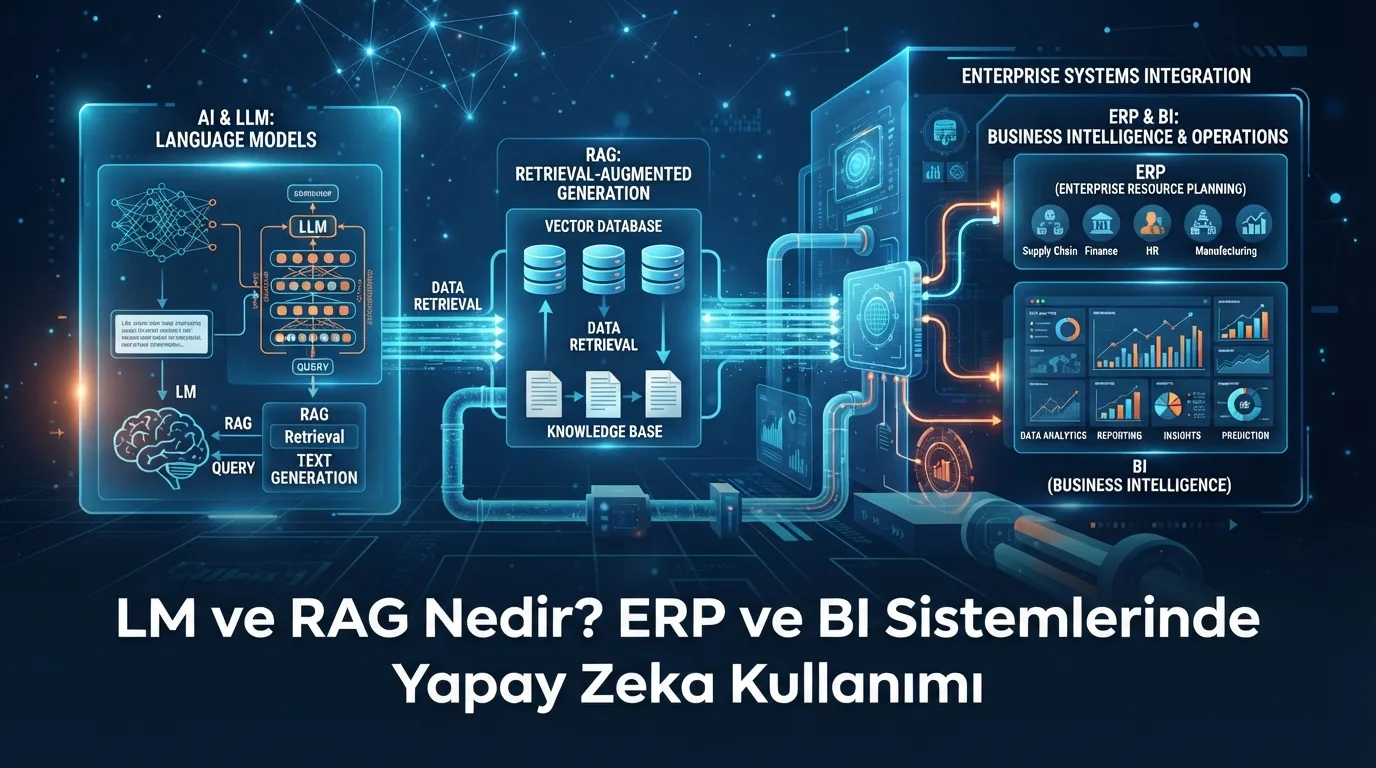
An LLM (Large Language Model) is an AI model that can generate human-like text; RAG (Retrieval-Augmented Generation) is an architecture that lets that model pull real-time information from your company’s own data while generating its answer. Combined with ERP and business intelligence (BI) systems, this pair makes it possible to answer questions like “what’s our current stock level?” or “what were our top 5 selling products last month?” in natural language, in seconds, without preparing a report. This article covers what LLMs and RAG are, the difference between them, and how this technology is concretely used in ERP/BI systems.
What Is a Large Language Model (LLM)?
A large language model (LLM) is an AI model trained on massive amounts of text data, which has statistically learned language patterns and can therefore perform tasks like answering questions, summarizing, and generating text. OpenAI’s GPT-4, Google’s Gemini, and Anthropic’s Claude are among today’s best-known large language models. These models generate answers by “recalling” the general knowledge they saw during training — but they have no direct access to a company’s specific, real-time data, such as its current stock level, an up-to-date account balance, or yesterday’s sales figures.
What Is RAG (Retrieval-Augmented Generation)?
RAG is an architecture that lets a language model “fetch” relevant information from an external data source (a database, an ERP system, a document archive) before generating an answer, and incorporate that information into its response. The term was first defined by Meta AI researcher (then Facebook AI Research) Patrick Lewis and colleagues, in an academic paper published at the NeurIPS conference in 2020.1 Put simply, RAG combines an LLM’s general language ability (parametric memory) with your company’s current, private data (non-parametric memory) — the model no longer answers based only on what it “knows,” but also on the real information it retrieves from your database at that moment.
Why Aren’t LLMs Alone Enough for Enterprise Data?
If you ask a plain LLM “which product did we sell the most of this month?”, the model either can’t answer or may “make up” (this is called hallucination) an answer that isn’t true. There are two main reasons for this:
- The training data is fixed: The model was trained on general data up to a certain date; it has never “seen” your company’s sales data from yesterday.
- It has no access to private data: The stock table in your ERP, the customer history in your CRM, or the account balances in your accounting system never appear in the model’s training data.
The RAG architecture closes exactly this gap: when a question comes in, the relevant data source (e.g., the ERP database) is searched first, the up-to-date and accurate information found is given to the model as “context,” and the model generates its answer based on that real data.
Traditional Reporting vs. RAG-Powered Querying
| Criterion | Traditional BI Reporting | RAG-Powered Natural Language Query |
|---|---|---|
| How you ask | Pre-built dashboard/filter menu | A plain sentence (“top-selling product last month?”) |
| Time to get a new report | Hours / days (waiting on the BI team) | Seconds |
| Technical knowledge required | May require SQL or BI tool knowledge | None |
| Freshness of the data source | Depends on report refresh schedule | Live data at query time |
| Unexpected / free-form questions | Limited to pre-designed reports only | Any question, in free text |
ÇAP AI-BI: Natural-Language Access to Enterprise Data via RAG
For most businesses, the real problem isn’t a lack of data — it’s that reaching that data is slow and requires technical knowledge. ÇAP Teknoloji’s ÇAP AI-BI solution applies the RAG architecture to your ERP and BI data, letting managers and teams ask questions like “what’s our collection status this week?” directly, in natural language, without waiting on a technical team. The system takes your question, searches the relevant ERP/BI data source, and delivers an answer backed by current, verifiable data — not what a general-purpose language model “guesses,” but what your database actually returns.
How Fast Is AI-Powered ERP Growing, According to Gartner?
This shift isn’t just a theoretical trend — it’s a concrete movement confirmed by industry analysts. According to Gartner’s research, the share of spending on AI-enabled cloud ERP solutions is expected to rise from 14% in 2024 to 62% by 2027.2 The same research firm forecasts that AI features embedded in cloud ERP will speed up financial close processes by 30% by 2028.3
What Does This Mean for SMEs?
RAG-powered AI isn’t a luxury reserved for large corporations. If anything, it delivers proportionally greater value for SMEs that can’t afford a dedicated data analyst: the owner or a department manager can ask their own question directly, without waiting on a BI team. A properly built RAG layer can eliminate a small business’s need for a “half-time data analyst.”
Frequently Asked Questions
What’s the difference between an LLM and RAG?
An LLM is the AI model itself that generates text. RAG is the architecture that lets that model pull information from an external, current data source while generating its answer. RAG doesn’t replace the LLM — it feeds it with your company’s real data.
Does ChatGPT or GPT-4 use RAG?
When features like web browsing or file upload are active, ChatGPT runs a mechanism similar to RAG. But integrating RAG into an ERP/BI system requires a separate, dedicated setup that gives the model access to your private, authorized enterprise data.
Does setting up RAG put our company data’s security at risk?
Not when it’s set up correctly. In a RAG architecture, your data is never included in the language model’s training; only the relevant, authorized section is read at query time, and that context isn’t stored after the answer is generated. Access rights and data source boundaries follow the rules you define during setup.
Do we need to replace our existing ERP system to set up RAG?
No. The RAG layer is a query/access layer built on top of your existing ERP/BI database; it doesn’t require replacing your current system.
Conclusion
Together, LLMs and RAG turn your ERP and BI data from static reports into a source of information you can query instantly, in natural language. This is an area that industry analysts forecast will grow sharply, directly speeding up decision-making even for teams with low data literacy. Get in touch to learn more about our Business Intelligence (BI) consulting service or to request a free quote and find out how your business can access its ERP/BI data in natural language with AI.
Sources:
1. Lewis, P. et al. (2020). Retrieval-Augmented Generation for Knowledge-Intensive NLP Tasks. NeurIPS 2020. arxiv.org/abs/2005.11401
2. Gartner, Predicts 2026: The Future of ERP — forecast share of AI spending in cloud ERP. gartner.com
3. Gartner Newsroom (February 2026). Gartner Predicts Embedded AI in Cloud ERP Applications will Drive a 30% Faster Financial Close by 2028. gartner.com